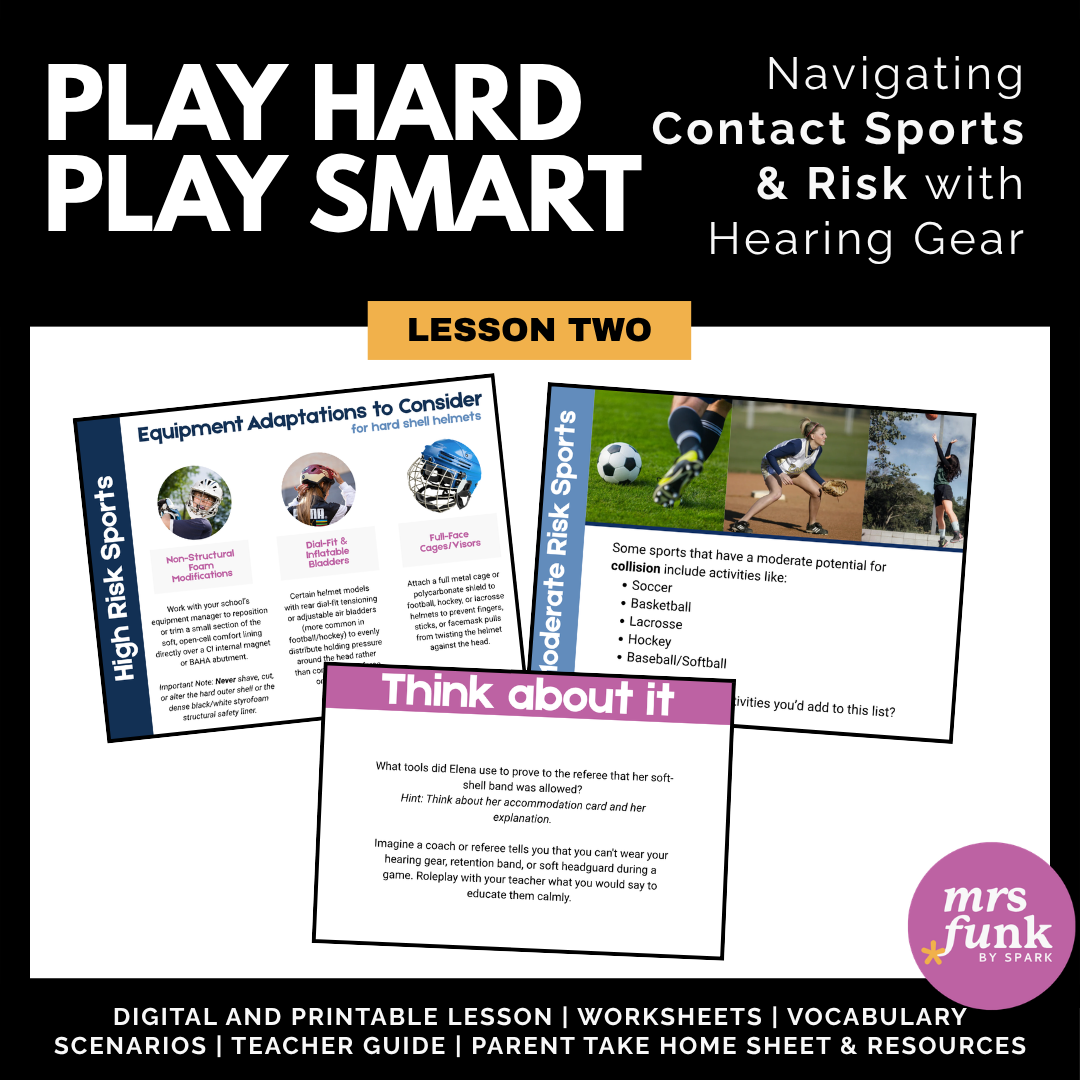
Are your DHH students playing sports with uncomfortable helmets, crushed processors, or painful hard earmolds? Do they know how to advocate for themselves when a referee questions their gear or when static electricity wipes their CI program on artificial turf? This low-prep DHH sports safety & self advocacy unit empowers DHH middle and high school students to play hard, stay safe, and take charge of their athletic accommodations.
What's Included?
Lesson plan for teachers including suggested pacing
Slideshow (and printable) lesson and with reading opportunities, real-life student scenarios, and prompts for discussion and reflection throughout. Covers topics like
categorizing sports into Low-Risk (Non-Contact), Moderate-Risk (Contact/Ball), and High-Risk (Collision)
risks affecting Cochlear Implants (CIs), Bone-Anchored Hearing Systems (BAHS/Baha), Hearing Aids, EVA, and Vestibular Systems
explanations of different soft-shell headguards, dial-fit helmet systems, soft silicone sports earmolds
and more like the "Metal Touch Rule" for artificial turf static.
Worksheet Activities (2) with Answer Keys
Sport Risk Sorting Challenge
Scenario-Based Adaptation Matrix: Fill-in-the-blank problem-solving scenarios focusing on equipment fixes, rule modifications, and advocacy scripts.
Vocabulary List of 20+ words from the lesson
Multiple formative assessment options for students to choose from to gauge their understanding.
Parent Resource that shares information on the importance of safety and sports advocacy as well as resources for finding DHH-specific protective gear for different sports and activities.
Potential IEP Objectives:
Student will independently roleplay/demonstrate self-advocacy skills by informing a coach, referee, or equipment manager about their medical gear (e.g., soft headguard, 'No Heading' rule) using appropriate scripts in 3 consecutive opportunities.
When presented with 5 sport-specific hazard scenarios (e.g., static electricity on turf, hard earmolds, water submersion), student will identify the risk and select the correct equipment adaptation or safety rule with 80% accuracy.
Given a scenario involving equipment discomfort, referee pushback, or a needed sports accommodation, student will independently state or write a 2-part self-advocacy statement explaining their technology needs and requesting a specific accommodation in 4 out of 5 trials with 80% accuracy.
No results match your search. Try removing a few filters.
